Child Support In California
After divorce and custody cases, child support is a significant expense for parents, funding children's care, and a parental duty. It’s important to know what to pay, where the money goes, and that it’s doing its job. This often presents a confusing proposition. With that in mind, we have answers to a few of the most common child support questions we hear.
What is Child Support?
What do payments cover?
Child support covers all the regular daily expenses of raising a child. This includes necessities like a safe, secure place to live, access to food, medical care, clothing, and even educational needs and child care.
If it’s a steady part of caring for your kids, child support encompasses it.
What child support doesn’t cover are the wants. Extras may factor into the amount, but for the most part, the child support formula only accounts for necessities.
Who Receives Support Payments?
After divorcing in California, the primary parent, the one with the most overnights and who spends the most time with the child, generally receives child support.
In most cases, these payments continue until the child hits 18 or graduates from high school, whichever happens later. There are, however, certain circumstances where it lasts longer. Your divorce decree and parenting plan should detail all of the specifics.
Related Reading: What Is A Parenting Plan?
How is Child Support Calculated?
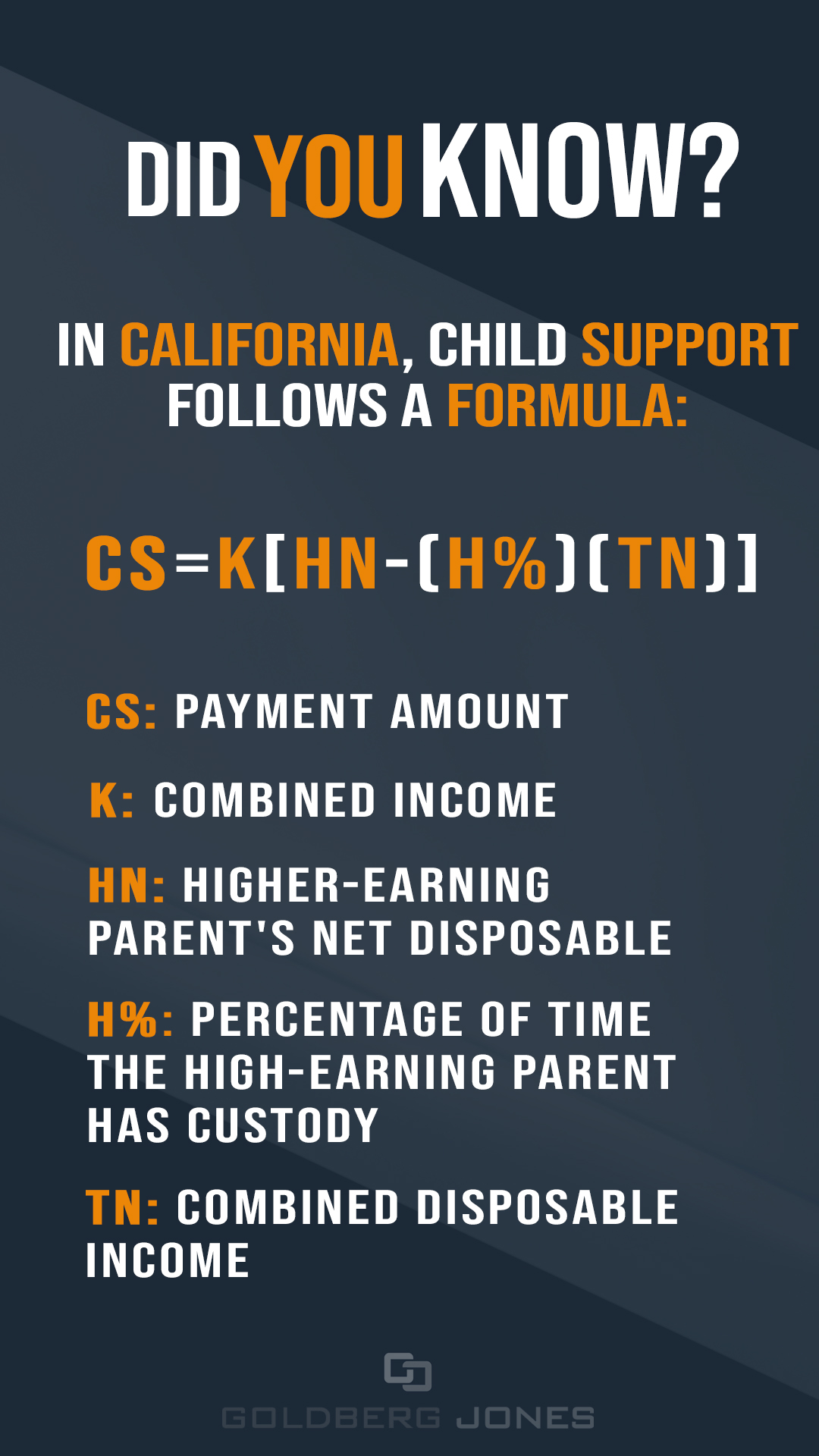
There is an actual mathematical formula used to determine the amount of child support payments.
The equation accounts for both parents' income, parenting time, level of need, and more.
CS=K[HN-(H%)(TN)]
CS: the child support amount.
K: the total of both parents’ income.
HN: the high net, or the total disposable income for the higher-earning parent.
H%: the percentage of time the higher-earning parent is responsible for the child.
TN: the combined net monthly total disposable income between both parents.
Related Reading: An In-Depth Look At Payment Calculation
Calculate Your Responsibility
To get started:
- Collect specific information about your income, finances, and taxes.
- Your most recent tax returns, paycheck stubs, and tax forms, like W-2s or 1099s.
- Paperwork that documents disability or unemployment benefits.
- Child health care costs.
- Mandatory fees like union dues or retirement contributions.
- Job-related expenses.
- Child support payments for other children.
- Spousal support payments.
- If you have similar costs, collect those.
Open Child Support Calculator (Will open in new window)
What Counts As Income?
- Wages, tips, and bonuses.
- Unemployment and disability benefits.
- Dividends.
- Interest.
- Bonuses or commissions.
- Public assistance.
- Social Security/pensions.
- Rental income.
- Prize winnings.
- Taxes.
- Tax deductions.
- Insurance.
- Union dues.
- Mandatory retirement contributions.
- Funds owed to any other dependents.
What Doesn't Count?
When Do Payments End?
Child support generally terminates at 18 or upon graduation, whichever happens later. It also ends if the child marries, joins the military, or becomes emancipated.
Parents can agree to continue support for longer if they like, such as through college.
In cases involving special needs, when a child requires ongoing care or resources, the custodial parent may request additional child support beyond age 18.